You know the moment. The day has been long, the to-do list has no bottom, and somewhere around 3 p.m. or 9 p.m., your hand is already in the pantry.
Afterward comes the familiar question: Why do I stress eat when I know better?
In more than 25 years of working with high-achieving women, and again in my doctoral research, I’ve come to the same answer. The craving was never the problem. It’s the last stop in a pattern that started much earlier, usually the moment you pushed past yourself. This is the heart of the Override Gap: the distance between what you know you need and what you do under pressure instead.
Why stress eating isn’t really about the food
Stress eating looks like a food problem because food is where the pattern becomes visible. It’s the part of the sequence with a wrapper, a calorie count, and a number on a scale.
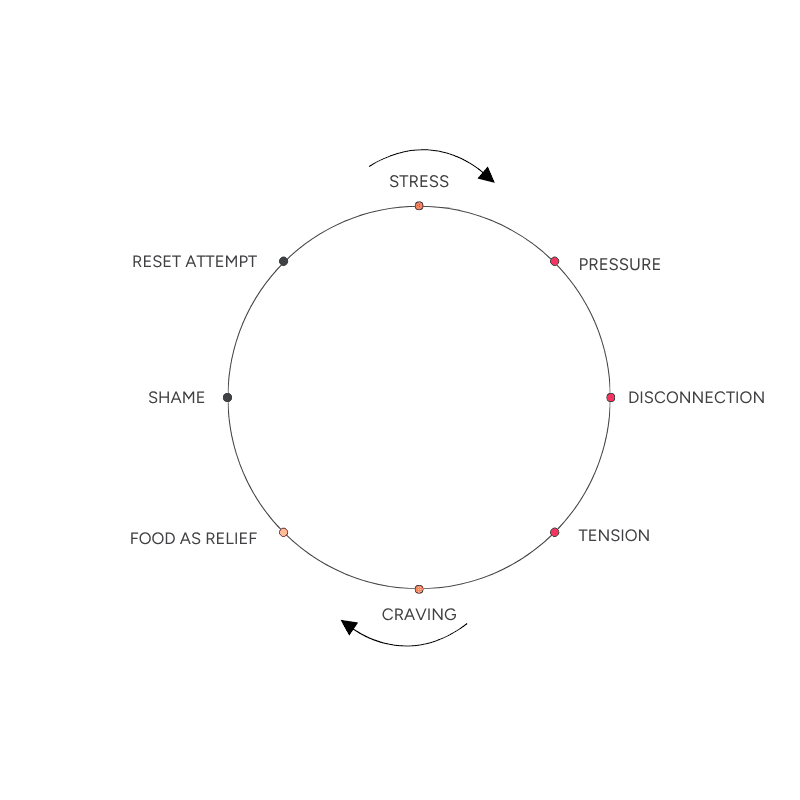
But look at what came before it. For most of the women I work with, the chain runs like this.
1. Pressure arrives. A deadline, a difficult conversation, a household that runs on your attention. Capable women absorb pressure all day, often without registering it as pressure.
2. You disconnect from what you need. Rest, a pause, a boundary, a real lunch, a moment to say “this is too much.” Under pressure, those needs get quietly overridden, because you’re competent and the day isn’t over.
3. Tension builds. Nothing has been released or named. It collects in the body as restlessness, irritability, a low hum you can’t quite place.
4. The craving shows up. This is usually the first stop you notice. By now, the craving is carrying everything the earlier stops left unattended.
5. Food becomes relief. And it works. Eating, especially something rich in carbohydrates, shifts your brain chemistry and settles the nervous system, which is part of why stress eating feels so effective in the moment. That relief is real, and it’s the reason this pattern can last for decades.
6. Shame and frustration follow. The calm fades faster than it arrived, and the inner verdict returns.
7. The cycle resets. Most women go one of two ways from here. Some restrict, promise that next time will be different, and reach for more willpower. Others think “I might as well enjoy it” and slide back into the pattern, a little more hopeless than before.
In both cases, the pressure that started the chain hasn’t gone anywhere. The only thing that changed is how hard you’re being on yourself.
Why willpower doesn’t stop stress eating
If food is stop five on a seven-stop route, willpower asks you to hold your ground at the very end, with the least information and the most accumulated tension you will have all day.
That’s a hard place to make a clear decision. It also explains why women who run teams, raise families, and keep complicated lives moving can feel completely undone by a bag of chips. It was never a character gap. The chain had been running for hours before you arrived at the pantry.
Notice, too, what the two paths after stop six have in common. Restricting and giving in both leave you managing food. Neither one goes back to stops one through three, where the pattern began.
Why knowing the reason hasn’t been enough
Many women already know the answer to why. You’ve traced it to childhood, to years of dieting, to the way your family handled stress, to a hard season you went through. You can explain your stress eating in detail.
And it hasn’t stopped.
Early in my practice as a psychotherapist, I believed insight was the missing piece. I assumed that if we uncovered the source of the pain, the eating would resolve on its own. What I found, and what my PhD research reinforced, is that understanding why doesn’t change what happens at stops two through five. Those stops are about what your nervous system does under pressure and whether you have a way to meet your own needs before the craving does it for you.
Understanding is valuable. It simply isn’t where the change happens.
Where the change happens
If the craving is near the end of the chain, the work moves upstream, to the places where the chain can still be interrupted. This is the Powerful Calm method, and it has three parts.
Calm is for stops one through three. It means learning to settle or regulate your nervous system in the moment pressure builds, so tension doesn’t pile up until food is the only release valve. Regulation isn’t about suppressing what you feel. It’s about giving your body somewhere to put it that doesn’t cost you the next hour of self-criticism.
Clarify is for stops two and four. Most of us were never taught to name what we feel with any precision. “I feel bad” or “I’m stressed” covers a lot of ground. Specific language (“I’m resentful,” “I’m depleted,” “I need someone to take this off my plate”) give you an opportunity you can respond to. Vague feelings are answered with food. Specific ones can be answered with what you need.
Connect is the return to yourself. It means making decisions from what your body, mind, and heart are telling you in the moment, instead of from the rules of a plan or the pressure of the clock. Sometimes that means eating for fuel because you’re hungry and busy. Sometimes it means eating for pleasure, without guilt, because you chose it.
When these happen upstream, the craving usually softens without a fight. There’s less left for it to carry.
It was never about the mashed potatoes
One Thanksgiving week, years ago, I wrote that it isn’t about the mashed potatoes, the pie, or the rolls. It isn’t about your weight, your willpower, or your childhood either. Those were never the end point.
What it’s about is learning to hear yourself sooner, before the pressure has done its work, and trusting that what you hear is worth acting on. It’s about stepping into your life more fully, including the parts that feel risky, such as saying no, asking for help, or changing a pattern that has felt safe for a long time.
If you’ve been waiting for the day you finally get control of food, consider that control was never the missing piece. Hearing yourself earlier in the chain is.
Where in the chain do you usually notice it? Many women tell me they only catch it at stop four. That’s a fine place to begin. Once you can see the chain, you can start moving your attention one stop earlier.
Conclusion
Stress eating can look like a problem with food, but food is where a longer pattern becomes visible. The chain starts with pressure, moves through overriding what you need and building tension, and arrives at a craving that carries everything the earlier stops left behind. Food brings real relief, shame follows, and the cycle resets.
That’s why willpower keeps losing. It asks you to hold the line at the end of the chain, with the least information and the most tension. It’s also why understanding your history, as valuable as it is, rarely stops the pattern on its own.
The change happens upstream. Calm settles your nervous system before tension piles up. Clarity gives you language for what you feel and need. Connection brings you back to your own voice, so your choices come from what you need rather than from pressure. When those are in place, the craving has far less to carry.
You don’t have to fix the whole chain at once. Notice where you usually catch it, and start moving your attention one stop earlier.
Frequently asked questions about stress eating
Why do I crave food when I’m stressed? Stress raises tension in the body, and your brain looks for the fastest way to settle it. Food does that quickly, especially carbohydrate-rich food, so the craving becomes a learned shortcut to calm. The craving isn’t a flaw. It’s a signal that something upstream went unaddressed.
Is stress eating the same as emotional eating? In practice, yes. Both describe using food to manage uncomfortable internal states. “Stress eating” tends to point to pressure and overload, while “emotional eating” covers a broader range of feelings. The chain applies to both, because the craving is the last stop either way.
Why does eating feel calming, even when I regret it later? Eating produces real, immediate relief for the nervous system, which is why the pattern repeats. The regret comes afterward, when the relief fades and the original pressure is still there. Both responses are part of the same cycle.
How do I stop stress eating without willpower? Move your attention upstream. Learn to settle your body when tension first builds, name what you’re feeling with more precision, and respond to what you need before the craving has to. When the earlier stops are handled, the craving has far less work to do.
Ready for a first step?
If you want a way to meet a craving in the moment while you learn to work further upstream, start with the Food is Not the Problem Solver. It’s a short guide to decode what you need in this moment.